For many transport operators, decarbonisation has moved from a future ambition to a present-day business priority. From customer expectations and sustainability targets through to compliance requirements and long-term operating efficiency, the pressure is growing on fleet owners to understand what the transition to lower- and zero-emission transport looks like in practice.
The challenge, however, is that for heavy commercial fleets, the pathway is rarely straightforward.
Unlike passenger vehicles, transitioning trucks and trailers to lower-emission solutions requires a deep understanding of route profiles, payload requirements, depot infrastructure, charging and refuelling capability, vehicle technology, lifecycle costs and long-term operational support.
Recognising this, TR Group has formally launched its End-to-End Fleet Decarbonisation Capability Statement, bringing together the company’s practical experience, engineering expertise and operational support capability into one structured market offering.
The launch formalises what TR Group has already been delivering in-market for some time — helping customers navigate the transition into battery electric, hydrogen fuel cell, hydrogen dual-fuel and hybrid heavy vehicle solutions.
Rather than focusing solely on the vehicle itself, TR’s approach covers the full transition journey.
This includes fleet discovery and emissions baseline analysis, route and duty-cycle assessment, infrastructure and energy review, vehicle selection, deployment support, driver familiarisation and training, and ongoing maintenance and performance reporting. As outlined in the newly released capability statement, the programme provides a clear six-stage pathway that allows operators to start small, scale over time, and transition in line with replacement cycles and technology readiness.
At the centre of this capability is TR Group’s in-house expertise.
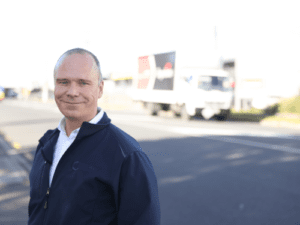
Scott Donnelly and Grant Doull are leading TR’s decarbonisation efforts, bringing a rare combination of heavy vehicle knowledge, emerging technological expertise and real-world operational understanding.
Their strength lies not only in understanding the technologies themselves, but in helping operators determine where each solution is commercially and operationally viable.
This practical lens is critical in a market where no single technology fits every application.
As Scott Donnelly explains:
“Decarbonising heavy commercial fleets is not about forcing one technology across every operation. It starts with understanding the task, the route, the payload and the customer’s long-term objectives. Our role is to help customers identify what is achievable today, what should be staged for the future, and then support them right through implementation and ongoing performance.”
Urban metro distribution may lend itself well to battery electric solutions, while linehaul and specialised applications may be better suited to hydrogen fuel cell or dual-fuel pathways as infrastructure and technology continue to evolve.
TR Group’s capability is built on proven experience rather than theory.
The business has already been at the forefront of deploying zero- and low-emission heavy vehicles across New Zealand, supported by its wider sustainability programme and the expertise of its nationwide team.
What differentiates TR’s offering is its ability to protect operators against many of the risks through Fully Maintained Operating Leases (FMOL) and act as a partner across vehicle choice, charging infrastructure, maintenance and ongoing fleet support.
For operators, this removes complexity, reduces risk and provides confidence that the transition is being managed by a team that understands heavy commercial vehicles first and foremost.
With the launch of this capability statement, TR Group is signalling clearly to the market that it has both the expertise and the practical experience to help businesses across New Zealand and Australia transition with confidence.